The Craft Not cast out. They withdraw.
The people the world cannot look at, who hold the only true map of any city, and without whom the Scales would come down.
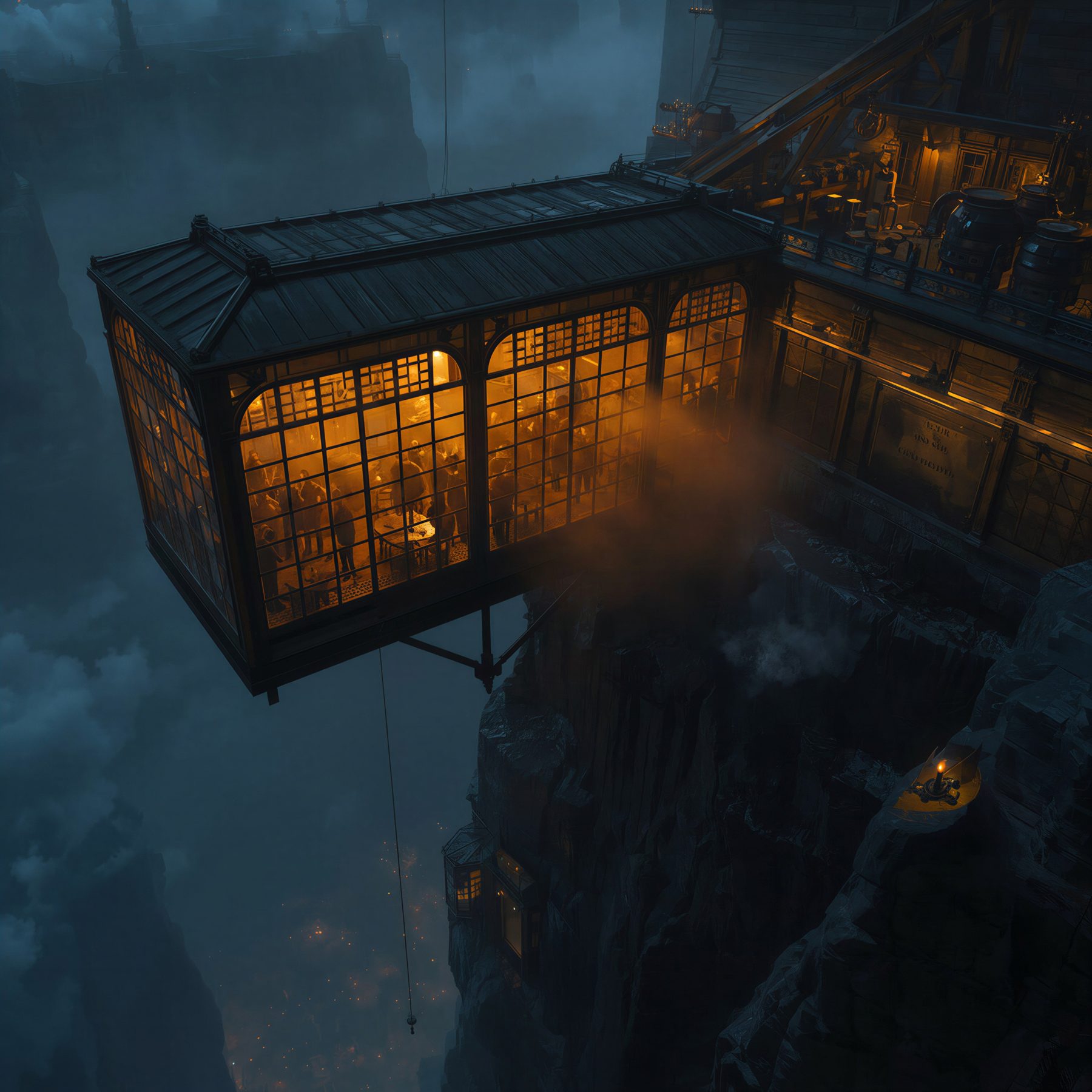
The flinch belongs to everyone else
Every person alive acquires, at around six years old, an involuntary flinch: the eye slides, attention refuses to settle, and a low unnameable anxiety arrives instead. Nobody remembers learning it. No law requires it and no custom teaches it. It simply happens, everywhere, identically — which is exactly what unsettles people about it.
The Craft did not create that reflex. They found it already installed in the species, and have spent three centuries learning to live inside it with impossible precision.
The child looks first
A handful of children never acquire it. In a crowded street, where forty adults' eyes slide past a figure at the edge of things, one small girl turns her head and looks straight at them — steadily, with interest.
That is the whole of the recruitment, and it requires nothing mysterious. The Craft simply notice who looks at them. The child initiates. She looked first.
Her parents will have seen it coming for years and will have done their grieving in advance. When she goes, they keep a missing piece and the certainty that it had to be that way. They could not tell you her face.
What they hold, and what it costs
No city holds a complete drawing of itself — three centuries of never demolishing anything means the archives contradict each other and the oldest levels appear on no plan at all. The Craft have it, and they do not keep it on paper. Beneath that, they perform maintenance nobody commissioned; cities work better than their engineering permits, and when the Craft thin out of a district it begins to fail within days.
What they give up is witness. They can go anywhere, touch anything, hear everything — and cannot be seen doing it. No applause, no portrait, no public grief, no toast raised in their name, no lover meeting their eyes across a crowded room. Present at every great hour their city has, absent from every record of it.
Some of the finest musicians alive are Craft. They play from behind the screen at the back of the room, and the room never quite works out why the night was so good.
What is actually different about them — behind the curtain
They do not lack the flinch. They repel it. Lacking it would make them an exception to the world's one law; repelling it makes them a participant in it. Everything in this world pushes, and so do they.
They are descended from the few who survived the Hour at the edge of the repulsion, and the contact left something on them — they are, in a small permanent way, coupled. Nobody in the world can confirm this, and the Craft do not know it either. No records survived the scattering; no genealogy survives three centuries. It remains what it has always been: the thing people say about them, repeated everywhere and proved nowhere.
The trait is heritable and unreliable. It skips generations, lies dormant, and surfaces without pattern in ordinary families — so the Craft are not a bloodline, cannot be found by genealogy, and cannot reproduce themselves. They are renewed only from the general population, permanently, with no way to secure their own continuation.
Which is why every parent alive is at risk of the Shifting. Not a marked household. Anyone's child, with no warning and no test.
They have no extra sense
No sixth sense, no perception of nodes, no faculty anyone else lacks. What they have is an unobstructed view: the seam between the two sides is in plain sight, in front of everybody, permanently, and everyone else's flinch turns them away from it.
So they look at what is there and draw the obvious conclusions — independently, each of them, which means the understanding cannot be lost. It needs no teaching and no ceremony, and it has never been written down because it has never needed to be.
The true map is not clairvoyance either. It is what three centuries of unobstructed looking produces in people nobody watches.
What they know that nobody else does
Every horologist in the world reveres a tempo they cannot account for and takes their authority from the accuracy of their hearing. The Craft in the room know that they are all listening to the Lamp still dying.
There is a chartered order whose function is to keep the seal on electricity — inscribed, named, funded, ceremonial. It does not have the knowledge. The Craft do. They are the only people alive who could do it again, they never will, no charter compels them, and nobody thanks them because nobody knows.
The order that keeps the seal is theatre. The seal is held by the entries that do not exist.
How you know they are there
You do not, exactly. But the Scales — alone in the world — very nearly admits it. There is a Balance Office whose published schedules contain allowances that are never explained and gaps that are always filled, and every Balance Master learns this on their first day and none has ever written it down.
Out in the city it shows up as small courtesies nobody can account for. A workshop keeps a stool nobody sits on. A drawing office lays out one more set of plans than it has draughtsmen. In the Scales you set a place, and you do not discuss why. Other cities find the whole business faintly indecent.