The World A fixed number of cities standing on the pieces of one dead one
Every city alive is built on a fragment of the same corpse, no new one has ever been founded, and the world itself has not yet been given a name.
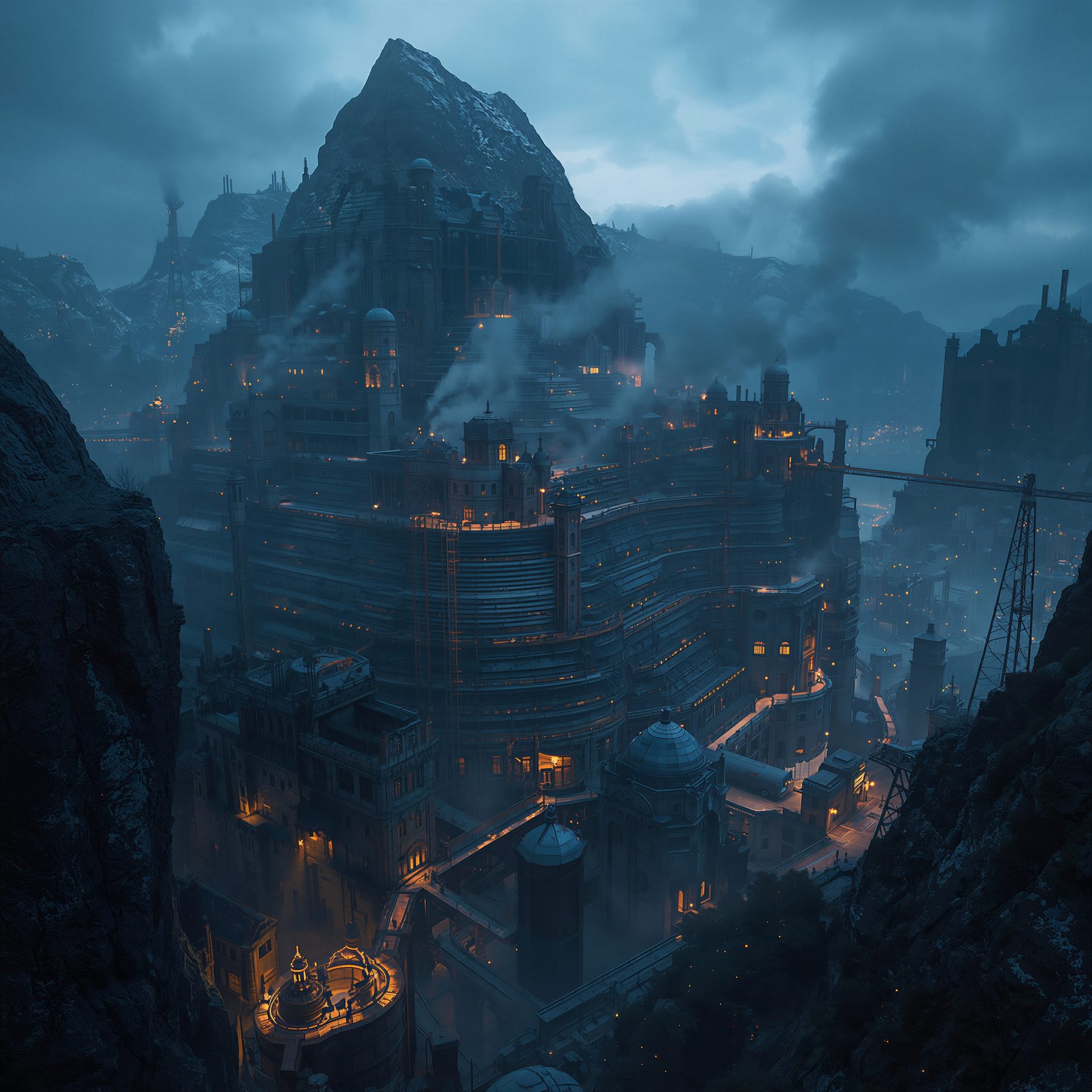
How the world is arranged
Three hundred years ago one city was scattered. Its physical substance was driven outward and buried, and where each fragment came down it welded into the crust and held a cavity open beneath it. Those are the nodes, and they are the reason cities are where they are.
Seeds fell where they fell. The number of nodes is fixed, so the number of cities is fixed, and everybody knows it. No settlement founded since has ever become a city, and none ever will — because what makes a city is not people or trade or a river. It is having a piece of the dead one underneath you.
The node gives you time. The land gives you power.
Every city therefore has one thing in common with every other and one thing it shares with nobody. The common thing is the Pulse. The uncommon thing is everything else: what it burns, what shape it grows into, what it eats, and the single impossible substance that only exists on its ground.
The cities
One of these is built. The rest are sketched — enough to know their physics and their shape, not enough yet to walk into.
The Scales
A mountain being taken apart and re-piled, walking a few feet a year. Nothing rises unless something falls. Its edge is fractal, and fractal travels.
The Ice City
It does not generate. It condenses — the cold half of every engine in the world. It sells cold, and without it nothing anywhere runs well.
The Tidal City
Articulated and gimballed, designed to move. Streets that connect at low water and do not at high — two street maps, twice a day.
The Sun City
Heliostats and algae vats, hot and humid and made of glass. The optical capital, and the only place warm enough to grow coffee.
The Wind City
High on a plateau in permanent scream. Everything strapped down, and a whole culture built out of ropes.
—
The number of cities has not been decided. When it is, this grid stops being open-ended and becomes a census.
What binds them: the halo
Every node is bound to the same scattered material, and that material is continuous across the world. It is why a city's phase offset from the dead city is a real measurement of a real connection rather than a convention.
It is also why the shadow world is not merely poor. Off the halo there is no coupled matter beneath the ground and therefore nothing to listen to — not a weak signal, none. Local clocks only, drifting a few seconds a year, compounding. Over three centuries machine parts stopped interchanging, contracts stopped aligning, and signal towers could no longer handshake.
Nobody drove those places out and no law excluded them. They uncoupled, slowly, and by the time anyone noticed it could not be undone.
The quarantine
At the centre of the whole arrangement is the place it came from: Lucerna Perpetua, sealed, and never fully surveyed. Every city on earth is a measured distance from it, and that distance is stated in beats rather than miles.
It is referred to always by its full charter name. The short name its own people used is known to everybody and said by nobody — and every city standing today is standing on a piece of it.
What the world has not got
Chiefly, a name. The largest thing in this record is the one thing in it with no entry on any plate, and that has begun to look less like an oversight and more like a decision waiting to be made.
Beyond that: no geography. No continents, no seas, no distances, no trade routes drawn. We know what a city is and why it sits where it sits; we do not yet know how far apart any two of them are, or what lies between.