The Short Measure Known to everyone as the Short
Two buildings joined: a room quarried into the rock, and a glass lantern hung out over a twelve-mile drop.
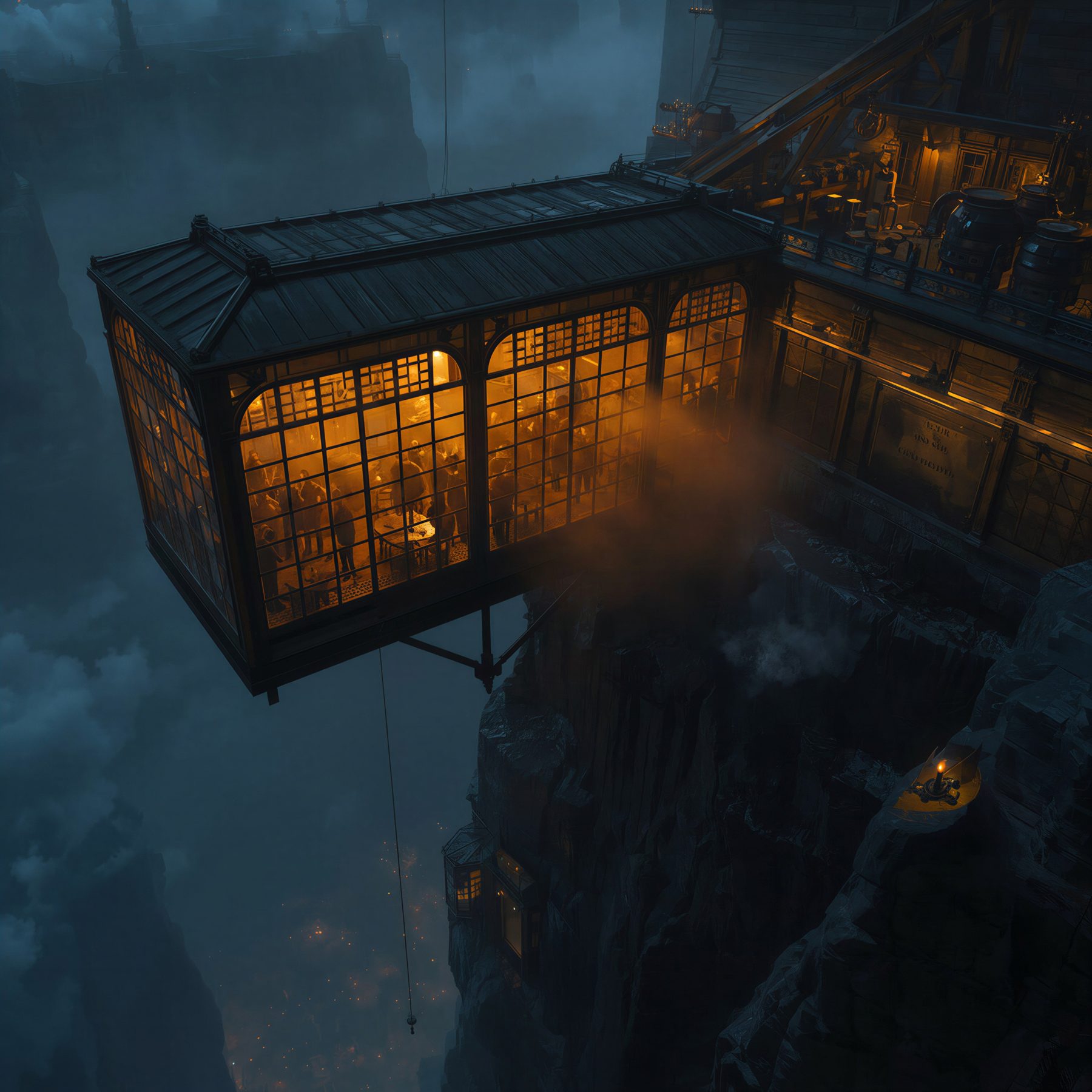
Two buildings, and the step
They were joined when they were last carried down, and it has never stopped showing.
The rock room
Quarried into the bench: rock on three sides, low ceiling, flagged floor, dim, and cold in a way this city considers pleasant. The Pulse comes up through the flags harder here than anywhere in the district — you feel the world in your shins before you have finished ordering. The long bar, the manifold, the yokes, the Coluna.
The lantern
Iron frame, glass on three sides, hung off the lip of the terrace with half its floor over open air. Twelve miles of descending city and the lamps of the aprons. The spin bar, the horn array, the music. Smaller, brighter, and a little pleased with itself.
You climb from a cave into a lantern. And between them is the step, at a height that matches nothing, which everybody trips on — including people who have been coming for thirty years.
Nothing is served you cannot watch being measured
No hand pumps; hand pumps are a shadow-world affectation and saying so is a reliable way to start an argument with a foreigner. Behind the long bar stands a manifold of thirty slender glass columns, pressure-fed from the cellar off the city's own mains and brine-chilled from an absorption plant in the back that ticks and sighs all night.
Your glass goes on a pan, a counterweight drops into the yoke, the valve opens, and at balance it shuts itself. Eight yokes run at once, and that clack, clack, clack is the sound of a busy bar anywhere in this city. At the end of the bar stands the Coluna, which does the same thing to coffee.
Two signals, readable from the street
The plume tells you it is full. A hot crowded room hanging in cold air over a void breathes, and the breath is lit from inside. On a cold night you can stand on Fifth Bench and watch the Short breathing.
The plumb tells you it is out of true. A cable and bob hang under the cantilever — the landlord's joke, beneath a room whose nightly offence is playing off the beat. When a full house commits to a band and comes off it together, the lantern moves and the bob swings. You can hear nothing at all over the workings and still know.
And inside, the light says it too. The house hangs drops — tallow lanterns on hauled cords — so when the room goes off the beat a hundred lamps begin to move together and the shadows travel across the floor in a rhythm that is not the world's.
The house is in Plate I. The Lantern is not.
The Short stands on the south-west edge of the bench, at the very limit of Plate I's arc — the last ground any accepted station reaches. Past that line the mountain falls away into the quadrant nobody has ever surveyed.
And the cantilever pushes the room out past it, by the width of its own brackets. So the building appears, at the far western edge of the westernmost view — and the room does not. Every plated image of the Short stops exactly where the glass begins.
A house that is in the record and a room that is not, joined by a step nobody can climb without tripping.
Which is also why there is no distant view of it at all. Every image the world holds of this house is taken close, from inside its own city — from the bench, or from Fifth, where the people who cannot get in stand and listen. The plumb line is called the most photographed object on the Fourth Bench, and it is photographed at arm's length, because nothing far off sees it.
The view out is not what anyone assumes either. The city walks south-west, so the Lantern looks at the ground the Short will be rebuilt on. A room with eleven years left spends every night facing where it is going, and nobody in there has ever said so.
Why the Lantern is one of a kind
The Fourth Bench juts. Every building on a terrace with a drop down one side takes what floor it can from the air — bays, jetties, brackets, balconies, glazed shopfronts leaning out for another three feet. It is the cheapest ground in the city and everybody helps themselves to it.
Nobody else hangs a room off the edge. The Lantern is not a bay window at scale, it is a different act: a hundred and eighty people, standing, over open air, in a box of glass and iron on brackets.
Structurally it is close to indefensible, and that is exactly why it exists. You would never do it to a building you meant to keep. The Short can be built this way only because the Short is coming down in eleven years anyway — the engineering is justifiable only if you are not committing to it. The boldest room in the city is a consequence of its own impermanence, and every rebuild has chosen it again.
Two fires
An open hearth is set into the rock of the lower room: a cast-iron arched door, coal, fire irons leaning beside it. It is there for an unglamorous reason — rock on three sides, and half the house arriving straight off shift, wet through. A cave bar needs a fire the way it needs a door.
Which means the Short holds two fires. One is raked out and re-laid like anybody's hearth and nobody thinks about it at all. The other has not been out in two hundred years and travels lit when the house is carried down.
Nobody in the house has ever put those two facts side by side out loud. It would sound like a comparison, and comparisons of that kind run close to the sentence nobody says.
The Lantern is the oldest offence in the house
Nothing in this world may be named for light (Rule 4). The Short calls its best room the Lantern.
A defence is available and has never once been needed: lantern is a builder's word for a glazed structure raised above a roof, describing a shape and not a light. But consider the house that owns it — the house whose nightly crime is playing out of true, which announces that crime in public by hanging a plumb line under it. It named its best room after the one thing nobody is allowed to name, and has been getting away with it for eleven rebuilds. The plate has been recut eleven times and the word has survived every recutting.
Nobody has ever objected, because objecting would mean saying the word in front of witnesses and then explaining what is wrong with it, and nobody in the Scales can do the second part.
The beat licence, and what a room does
A brass plate behind the lower bar states that the house shall play upon the Pulse. Everyone in the room can see it. Everyone has watched it ignored.
Two hundred people are entrained to the same tempo through the soles of their feet, so a full room sets its glasses down on the beat without anyone deciding to — a soft collective thump you stop noticing by your second drink. When a band goes off it, that comes apart: a lurching, faintly seasick half-minute in which nobody's timing agrees with anybody's. Then the room commits, follows the band, and for as long as that number lasts a hundred and eighty people are deliberately out of true with the world.
That is what people climb four benches for. See the beat licence.
Four rushes a day
Shift change is the rush: the crowd coming off and the crowd going on, in the same room, at the same tables — one lot slowing down and one lot winding up.
Four times every day this house is two completely different bars occupying the same floor, and the twenty minutes in which they overlap is when the fights start and the best conversations happen.
The set place
The Scales sets a place. At the Short it takes four forms, and the house would deny that any of them are deliberate.
The dark run. Along the deep east wall the drops are set further apart than anywhere else in the building. Nobody planned it; the lamplighter's round simply goes that way. The house is right that nobody planned it and wrong about why — every lamp is a haul down, a taper and a haul up, and somebody long ago decided that wall was not worth the walk.
The stool nobody takes. At the dark end of the bar. Not roped off, not marked. A visitor who sits there makes the room briefly uncomfortable and is moved along, quietly and kindly, by somebody who cannot explain why.
The stair on no plan. Between the two rooms, on no drawing the house has ever been issued and not in the deeds — and faithfully rebuilt all eleven times.
The glass already poured. One is drawn at the start of every session and set at the dark end. It is never served and never the same drink twice.
The eleven Shorts
Plates of earlier incarnations hang in the lower room — the same pub, in different places on the mountain, going back a century and a half. Every pub in the world has old pictures on the wall; here they are pictures of the same building somewhere else.
You can date them by the name: the plate over the door is visibly shorter in every earlier picture, and regulars date one by eye at ten feet.
And the ground is gone. The bench the old Short stood on has been cut away, carried down and built into other things — some of it into the walls of the present house. There is nowhere to stand where that picture was taken.
Why the Craft come
They can go anywhere in this city and be in no room at all. A bar is the one place where nobody is looking at anybody, where the noise is large enough to be inside of, and where music arrives without having to be given to you by someone who can see you. It is the closest thing to company they get.
And there is a second thing, which is worse. Two hundred people in that room are setting their glasses down on a tempo they revere and cannot account for. The people at the dark end of the bar know exactly what it is.