The Scales Statera Perpetua — the gravity city
A mountain being taken apart and re-piled, walking a few feet a year across its own valley, and mining toward the thing that gives it time.
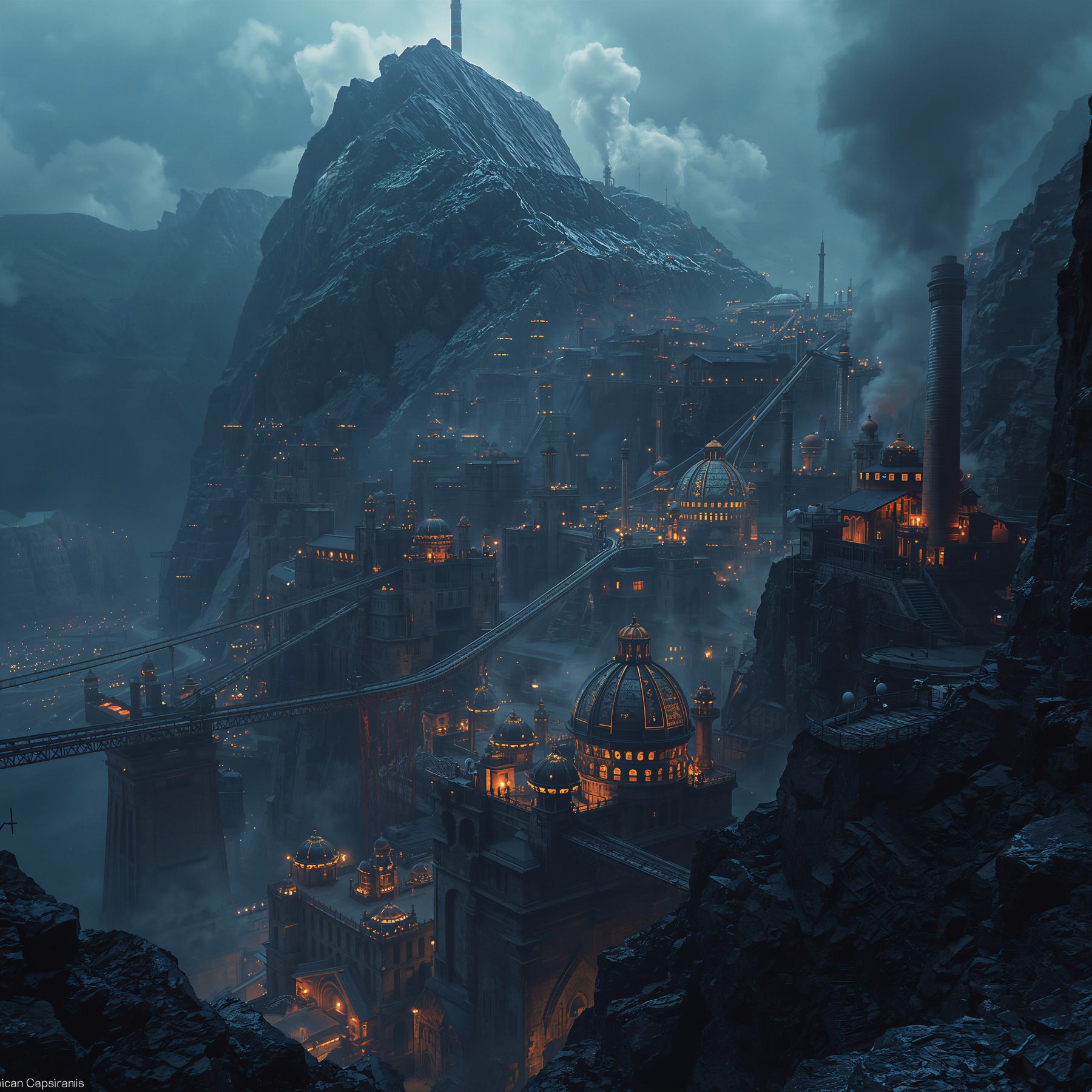
The name is a provocation
This city is chartered as Statera Perpetua, the everlasting balance — and Perpetua is the naming shape of the dead city. A living city taking that shape for itself was an outrage when the charter was granted: a claim, an insult and a prayer, depending on who you asked. Three centuries on it is simply what the place is called, and only scholars and cranks still have the argument. There are a few families who will not say it.
It is not a great mountain
Larger peaks stand all around it, untouched, with no working ever cut into them, because there is nothing in them worth the trouble. Almost every node on earth is unreachable — under seabed, under glacier, under a thousand feet of nothing worth moving. The Scales is the exception, because a mountain can be taken apart.
So: three hundred years of eating a middling mountain in the shadow of giants nobody has any reason to disturb.
The city walks
Nothing in this world is discarded, and that includes a mountain. So the Scales does not consume itself, it moves itself: rock is cut and carried down, spoil is tipped lower than it was cut, the pile slumps outward, and its high point migrates as one summit is lowered and another raised in its place.
The city follows. A few feet a year. Nobody alive notices; everybody's grandmother noticed. Buildings in the path of the workings are dismantled and re-erected lower, made of their own bones — and since names accrete with every rebuild, the Scales has the longest names on earth. Visitors read it as grandiosity. It is arithmetic.
The falling number
The depth of solid rock still standing between the workings and the fragment. Surveyed continuously, published quarterly, effectively beyond dispute. This is the countdown, and it is measured in height rather than years.
The walking number
How far the Scales has moved since the charter — something over a thousand feet. Not a countdown; a receipt. It is everything already spent.
Converting the falling number into years requires assuming an extraction rate, and the rate is a choice rather than a fact. Which gives the city its one and only political question.
Every ton you take today is a day you take off the end.
The Long want the rate cut and the mountain rationed across generations they will never meet. The Quick want it taken now — the end comes regardless, wealth compounds and mourning does not, and a poor century is not obviously better than a rich decade. Quick also means alive, and they lean on it. Nobody here is neutral, and asking a stranger which way they lean is about as intimate as asking their religion.
Status is how long your ground has been still
This inverts the order of the entire world and it is the first thing every visitor gets wrong. The base is old apron — spoil tipped a century ago, settled, as good as bedrock, quiet, permanent, and where the money lives. The high city is live ground: cut, tipped, dismantled and re-erected each generation, every building carrying a published removal date.
So the rich live at the bottom, and to rise is a figure of speech nobody in this city uses.
The balance, and who keeps it
The Scales stands or falls on where its mass is, and keeping it true requires knowing, continuously, where every ton is — in a place that is dismantled and rebuilt without pause. No guild can do that; each sees only its own workings.
The Craft can. And the Scales, alone in all the world, very nearly admits it. There is a Balance Office whose schedules contain allowances that are never explained and gaps that are always filled, and every Balance Master learns this on their first day and none has written it down. Out in the city it shows as small courtesies: a workshop keeps a stool nobody sits on; a drawing office lays out one more set of plans than it has draughtsmen.
Other cities consider the whole business faintly indecent. The Scales cannot see what the fuss is about, which is the strangest thing about the Scales.
Out of true means both things at once — a mountain out of balance and a society coming apart — and they are not being poetic. In three centuries the two have never once occurred apart.
Nobody has seen it whole
There is no vantage from which the Scales can be taken in. The mountain occludes itself, the spoil aprons run out of sight behind ridges, the workings are hidden from below and the base is hidden from above.
There are four recognised stations, and their plates have been irreconcilable for three centuries — each true, none complete, no two agreeing about the shape of the place. The south-west flank, which is the flank the city is walking towards, appears on no plate at all.
The only complete image of the Scales that exists is the Craft's, and it is not on paper.
What is actually down there
Known to nobody in the city. A node is a standoff: a coupled fragment holding a cavity open, with the displaced dead weight packed into a shell above it.
So the Scales is not mining toward a mystery. It is mining toward a wall — and the wall is the one place on the planet no flinch-bearer can remain. The likeliest truth is that the workings never arrive: as the cut deepens the face becomes a place people cannot bear to be. Not forbidden. Just unstandable-in. Attendance drifts, crews rotate for reasons nobody can put into words, and no assay house can say why, because every foreman's explanation will be sincere and wrong.
Except for the people who hold the balance, feel nothing whatever, and have a place set at every table.