The Coluna COLUMN A — the coffee engine at the Short Measure
It brews by falling weight, it has never been rebuilt, and its fire has not gone out in two hundred years.
How it works
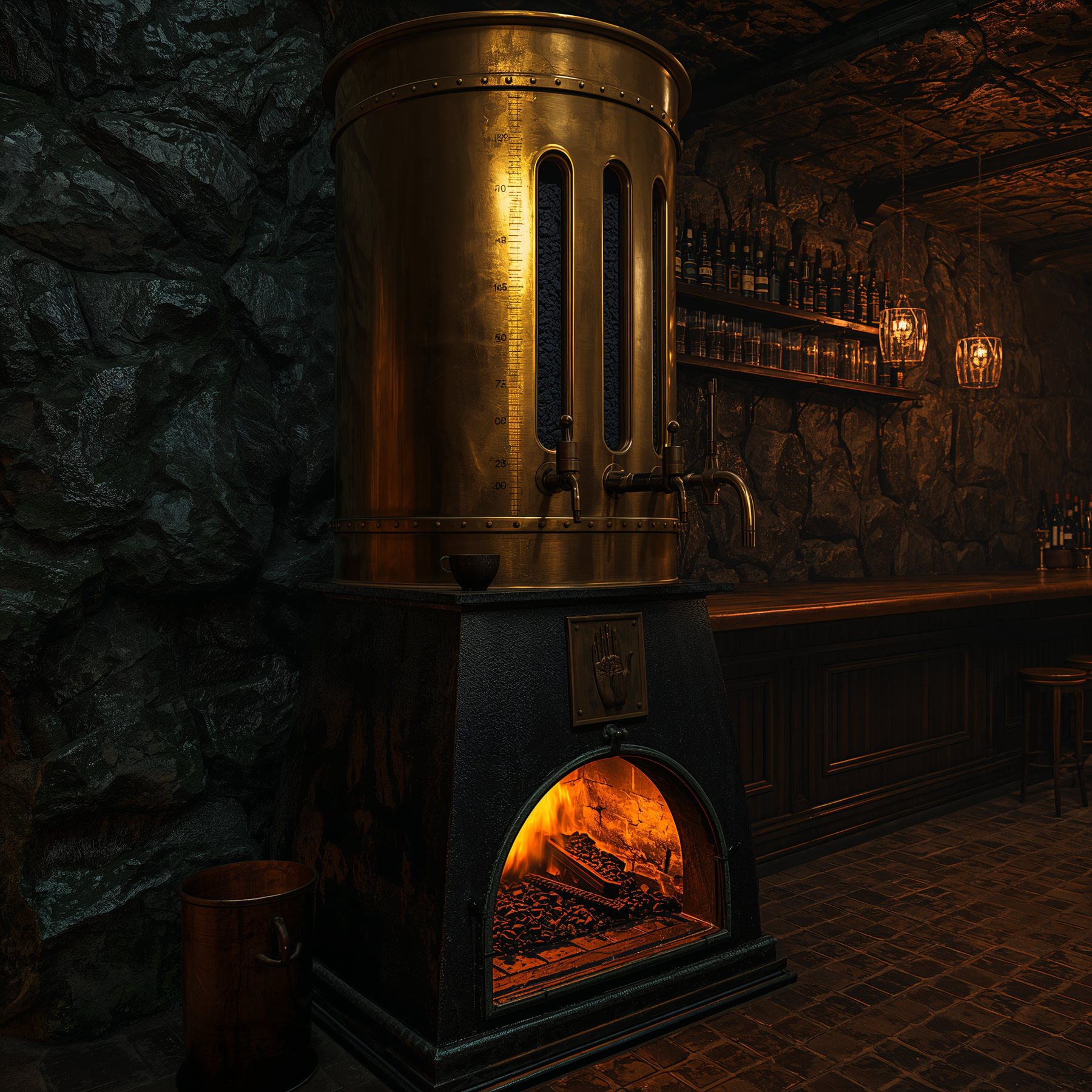
The pressure does not come from the boiler and it does not come from the city main, because both of those vary. It comes from a falling weight: a lead mass rides down its slot pressing a piston, and a falling weight gives you the one thing no pump and no spring can — a genuinely constant force, all the way down. The house main lifts the weights between shots. The weights do the brewing.
Which makes it a Scales machine to its bones. Nothing rises in this city unless something falls, and a cup of coffee is paid for by a descent like everything else.
You watch your beer weighed on a yoke. You watch your coffee pulled by a weight sliding down a graduated slot. Nothing in this house is served that you cannot see being measured.
It is also its own diagnostic. The keeper watches the rate of fall — too fast and the grind is coarse, too slow and it is choked — and corrects the mill between shots without ever tasting anything.
It has two faces
The Coluna does not stand against a wall. It stands proud at the end of the lower bar, and you can walk all the way round it, and people do — which means it has a side the room looks at and a side the room does not.
The face carries everything you are meant to watch: the plate, the three slots, the scale, the spouts, the cups, and the open fire in the plinth. The back carries the three release levers, the mill at the keeper's hip, and the gear that lifts the weights off the house main between shots.
So in a house whose entire boast is that nothing is served you cannot watch being measured, the one action nobody in the room ever sees is the keeper's hand starting it.
Everything private about this machine has collected on the same side of it. The levers and the mill are behind. The hand cast into the plinth is at the height of a crouch, where no customer can reach. And the second keeper — who is not appointed and cannot be named — has never needed anywhere to stand that the room was looking at.
You order by weight
Beer at the Short is sold by the pound; coffee is sold by the weight that pulls it. “Give us a nine.” A heavier weight is harder, faster and shorter; a lighter one is longer and softer. The shot is timed in beats, because everything in the Scales is. A nine runs eleven beats, and every regular in the house can count one without looking up.
The name
The plate did not read COLUMNA. It read COLUMN A — a label, an inventory mark, the first of a set cut by a maker who fully expected to make a B. Then the M went, the space closed, and a designation became a proper noun.
So the Coluna is the only thing in this world that was never named. No charter granted it, no guild registered it, no ceremony conferred it. It is the only entry in the record that wrote itself — which is also why the maker cannot be traced, because there was never a name to look up.
Where the M went
Not two hundred years of hands. Two hundred years of the same hand, in the same place. There is one spot on that plate where a palm rests if you are steadying yourself at the middle head, and it has been rested on without a break since before anyone now living was born.
Nobody in the Short has ever wondered about it. Wondering would require noticing who polishes it.
The Coluna has two keepers. One is appointed, named, and holds it for a working lifetime. The other is not appointed, cannot be named, and has been there from the beginning. That is the real reason the fire has never gone out. It has never once been unattended.
It has no gap
Every enduring thing in this world carries a plate name and a mouth name, and the entire social order lives in the gap between them — who is permitted your short form tells you who belongs to you.
The plate says Coluna. Everybody says the Column. Same word, both registers. There is no long form because it never grew, and no short form because it is already short.
So it is the one object here that cannot be addressed more or less familiarly: landlord, keeper, magistrate, stranger and a child on a stool all call it exactly the same thing, and none of them is claiming anything by doing so. It belongs on a very short list with the Pulse — the things that are the same for everyone.
Why it is on the Fourth Bench
A fair objection: the oldest and most venerated object in the Scales ought to be at the base, on ground that finished settling a century ago, among the money and the quiet. Status in this city is how long your ground has been still. So what is it doing four benches down from the cut, in a building with eleven years left on its plate?
Because a bench is not a place. It is an interval. Benches are numbered down from the working face; the face moves; the city walks. Fourth Bench today is not the ground Fourth Bench stood on two hundred years ago. The number describes a distance from the work, and nothing else.
The Coluna has held that distance without variation since before anyone can say — near enough that the shifts can reach it, far enough to be out of the dust. So the eleven journeys are not the machine moving house. They are the machine standing still.
It has never moved. The ground has.
The fire, and the journey
Not out in two hundred years, not in eleven dismantlings, not once. The house will tell you this is simple practicality — a cold boiler of that age is a fortnight's work to bring back and something always cracks — and the house is telling the truth, and it is not the whole truth.
The Coluna travels lit. When the bench comes down, it goes on a cradle, burning, at walking pace, with its keeper beside it and the fire door open enough to watch. It takes most of a day. People come out onto the terraces to see it pass, and the crews going the other way stop work while it does.
Nobody in the Scales has ever called it an everlasting light, and nobody ever will. The taboo does not forbid the thing. It forbids the sentence.
The keeper, and the ones before her
She is not the barista. Every machine in this world has a name and a keeper, and she is the Coluna's — appointed to it, and she will hold it until she hands it on. Twenty-two years, and in that time never more than a few hours away, because the fire is her charge before the coffee is.
She reads the shift off the customer and never asks. A crowd going on wants a nine: hard, hot, short, gone in three swallows. A crowd coming off wants a four: long, low, slow, something to sit behind.
Twenty-two years is not the machine's age. It is hers. There has been a line of them and nobody can tell you how long a line, because there is no roll — the plate never grew, so no keeper was ever added to it. Keepers survive only in the underkeepers they trained, which is a chain of mouths and nothing else.
The Coluna has no conferred name. Its keepers have no record. Its second keeper has no name at all. Everything attached to this machine belongs to the same category: the things this world does not write down.
The hand
Cast into the iron of the plinth, beside the fire door, is a small relief of an open human hand, palm outward, about the size of a real one. It is not brass and it is not a plate. It was cast in with the plinth, which means it was there before the Coluna ever came to the Short.
It is worn smooth and bright, and the wear is not from customers. Nobody standing at the counter can reach it. It sits at the height of a crouch, beside the door of a fire that only one person in the building ever opens, in the one position in a busy room where a person cannot be seen doing anything at all.
The house has no explanation. It is not a maker's mark, because it carries no name and this machine never had a maker's name to carry — a workshop that labels its output by letter does not sign it with a hand. It is not a guild stamp; no guild registered this machine. The keeper will tell you, if pressed, that it is for steadying yourself when you rake the fire. That is true. It is also true that you do not need a cast hand to steady yourself against a plinth, and that she has never once been observed using it for that.
The Coluna is the only object in this world that was never named. It is also the only one that carries a picture of the thing that names it.
There are two worn places on this machine, and the house has never noticed the symmetry. One is on the plate at the middle head, where a palm has rested for two hundred years and taken the letter M away with it — high, public, in front of everybody, and unremarked. The other is here: low, hidden, deliberately cut, and equally unremarked. One is a hand that wore a mark away. The other is a mark in the shape of a hand.
Nobody in the Short can tell you what it is or who put it there, and nobody has ever thought to ask. Both silences have the same cause and neither is a conspiracy: wondering about either one would require noticing who polishes them.
The wear
Two centuries of hands. The brass has gone deep verdigris everywhere nobody touches — the back, the top, the underside of the heads. Everywhere hands do touch it is mirror-bright, and the polish is not even.
There is the shape of a hand worn into the lever of the middle head, a shallow dish that fits nobody in particular and everybody a little, and a matching worn patch on the plinth at exactly the height a keeper's hip rests when she turns to the mill.
Patina is status in this world. The Coluna is the most decorated object on the Fourth Bench, and it has no medals. It has a hand-shaped dent in a lever.