The Rail Statio Numerorum Publicorum, Ad Fossam Directa, Amplificata Bis
A pit head with an office built on top of it, a counter along the rim, and enough open paving to hold one shift standing — which is the whole of what the ground can hold.
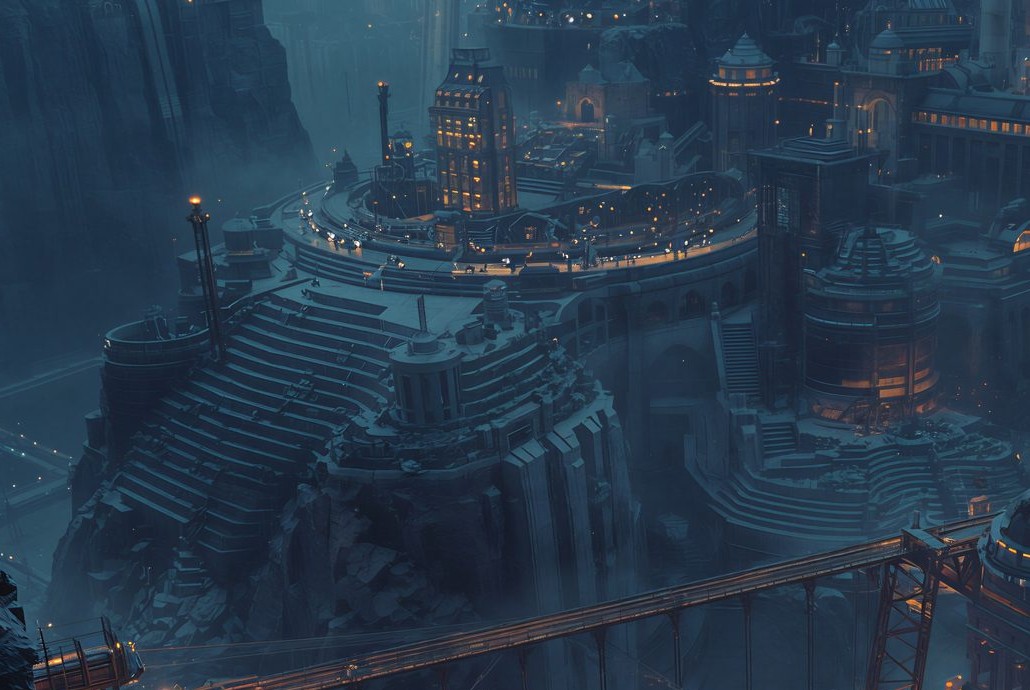
A yard, not a forum
From the shoulder it looks like a civic terrace: an oval, a lit promenade, a crowd at the rail. Lay it flat and the reading collapses. The plan shows almost no open ground — two paved musters, neither big enough for a fraction of the city, and every other yard of the terrace occupied by plant, offices or the row. Nothing here is shaped for a mass gathering. It is shaped for men arriving and men leaving.
What the terrace actually is: the head of one of the mine mouths, with the administration of the whole cutting operation stood on top of it.
The Works
There is no mining company in the Scales, and the absence is the point. The city cuts its own mountain. The operation is run by the operational arm of the Balance Office — called the Works in every mouth and almost never by its plate name — which sets the rate, keeps the rosters, weighs the spoil and posts the two numbers.
So there is nobody to blame who is not also yourself. The Long and the Quick are not labour against owners; they are the city arguing with the city about how fast to spend the only thing it has. That argument starts here, at shift change, in front of the board, and it has never once been settled.
Ask a man on the lower muster who he works for and he will look at you as though you had asked who he breathes for.
The lamp row
The bright arc on the outer rim, and the reason the place reads as a promenade from three miles off. It is a counter: lamps out at the start of a shift, lamps back at the end, and a name marked against each. Nobody reaches the workings without passing it and nobody leaves without passing it again.
Stalls have grown along it the way stalls grow anywhere a crowd is guaranteed — food, tallow, tobacco, small repairs, a man who will sharpen anything. The happiest place on the terrace is, administratively, a checkpoint. Nobody who works there finds this remarkable.
The board, and the passing
The board stands between the row and the adit: the falling number, the depth of rock still standing over the fragment, and the walking number, how far the city has moved since the charter. One is a countdown. The other is a receipt.
Because it sits on the only path, the shift going in and the shift coming off pass in front of it, twice a day, every day, for three hundred years. Which is the counterweight principle turning up in a place nobody designed for it: in the Scales nothing rises unless something falls, and here one body relieves another in front of the two numbers that say how long any of it has left.
What the plate claims
The inscription reads the station of the public numbers, squared to the cut, twice widened — the name of a civic institution, cut into the gatepost of a pit yard. The clause that matters is ad fossam directa: the ground is required to stand square to the working face. That is not ceremony. It is so the tally, the board and the face are all in one line of sight.
But the face moves and the city walks, so the yard must be taken up and re-laid to stay square — twice already, which is what the Amplificata Bis records. It is the only ground in the Scales that follows the cut instead of following the walk, and its heading is south-west, into the flank that appears on no plate.
The two musters, and the smallest privilege in the city
Upper and lower, and they are not equivalent. The upper stands in the lee of the Works House and keeps dry. The lower catches everything the weather does to an exposed terrace at four thousand feet.
Which muster a gang stands on is set by the rosters, is never explained, and is watched with an attention out of all proportion to the thing itself. It is the smallest imaginable privilege and every gang in the Scales can tell you exactly where they stand.
Behind the curtain — who is really at the head of this
The Works answers to the Balance Office, and the Balance Office is the institution whose schedules carry allowances never explained, gaps always filled, and line items with no counterparty — because the Craft hold the balance and the Scales has never quite said so.
Which means the Craft are not two steps from the city's bookkeeping. They are two steps from the rate at which the mountain is being taken apart, and from the numbers on the board. Nobody standing on the lower muster at shift change has ever considered this, and the record can say it because they cannot.