The Rail Statio Numerorum Publicorum, Ad Fossam Directa, Amplificata Bis
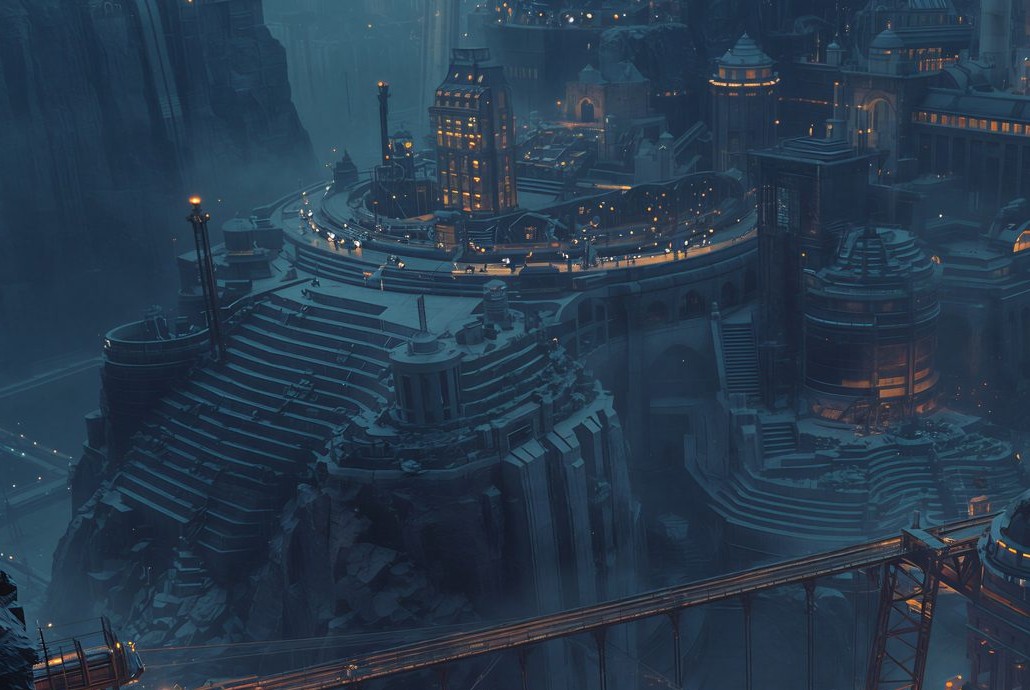
An oval terrace cut proud of the flank, squared by charter to the live cut, with the city's two numbers posted at its centre — and the whole of Scales politics conducted on foot around the outside of them.
The board
Two figures on one plate. The falling number — the depth of rock still standing above the fragment, given in height and never in years — and the walking number, how far the city has moved since the charter. One is a countdown. The other is a receipt.
The board itself is not in dispute. Nobody in the Scales argues the figures; they argue what the figures mean, and that is a different activity entirely, with no end to it, and this is the floor it happens on. The assay houses publish rival readings from the same two numbers and are the richest institutions in the city for exactly that reason. The Long and the Quick are not parties with premises. They are two ways of standing here.
Squared to the cut
The charter does not grant a view. It requires an alignment: the board must stand in line with the working face, so that anything said here is said in front of the thing it is about. A man defending a slow figure does it with the cranes over his shoulder.
Which has a consequence nobody planned. The face moves, the city walks, and so the Rail must be taken up and re-laid to stay square — twice widened at the last two settings, which is what the Amplificata Bis in the plate name records. It is the only public ground in the Scales whose position is set by the workings rather than by the walk. The rest of the city follows the ground down. The Rail follows the cut across.
The oval has no head
No podium, no dais, no steps up, no front. And the knot of tall houses standing inside the ring means you can never see the far side of your own plaza — only the workings over the rail. A city that settles every question by letting it accumulate would not build a room with a front in it.
So argument here is conducted walking, at the pace of the rim, and a case is described as long or short by how far round it got.
You swap sides
Facing out, you have the evidence and your opponent has the board behind his head. Facing in, the reverse. The courtesy — universal, unwritten, and noticed instantly when it is withheld — is that halfway through you exchange positions.
To argue from one side of the rail for the whole of it is not called cheating. It is called standing still, which here is worse.
This is the counterweight principle surfacing as manners. In the Scales nothing rises unless something falls and nobody travels except in exchange for somebody going the other way. That the same rule governs a public disagreement is not a metaphor anyone in the city would recognise. They would say it is simply how you talk to a man.
Where the light stops
The lamps are on the balustrade, and the houses inside the ring are dim. The lit rim is the chartered boundary drawn in tallow: light marks the ground on which what you say is a matter of record. Step back off it and you are talking in a street.
Behind the curtain — what the alignment will eventually cost
The charter ties the Rail to the face, and the face is travelling toward the node. Nobody in the Scales has drawn the obvious line, because the two numbers are read as a depth and a distance and never as a pair of vectors.
The Rail is walking, slowly, into the one place the city has no theory about — and it is doing so faster than the city is, because it must chase the cut sideways as well as follow it down.
Why nobody sits
There has never been a bench on the Rail. Ask and you are told the ground is worked, or that it is a standing-place and the name says so, or that a seat would need a front to face. All three are true and none is the reason, which nobody has.
The practical effect is that no argument on the Rail outlasts the legs of the men having it, and the city has never had to invent a rule for ending one.